When it comes to ball valves, understanding the different types is key to selecting the right valve for your application. Two of the most common OEM ball valve designs are the trunnion mounted ball valve and the floating ball valve. Although both serve the purpose of flow control by using a ball to open or close the passage, their design and operational characteristics differ significantly. In this article, we'll break down these two valve types, their differences, advantages, disadvantages, and help you decide which one fits your needs best.
A ball valve is a quarter-turn valve that uses a hollow, perforated, and pivoting ball to control flow through it. When the ball's hole is aligned with the flow, the valve is open; when it’s rotated 90 degrees, the flow is blocked.
Ball valves are prized for their:
Quick operation
Reliable sealing
Durability in harsh environments
But not all ball valves are built the same.
A ball valve floating type features a ball that is free to move slightly downstream within the valve body. It is supported only by the two seats (usually made of soft material like PTFE), which press the ball tightly against the downstream seat to create a seal.
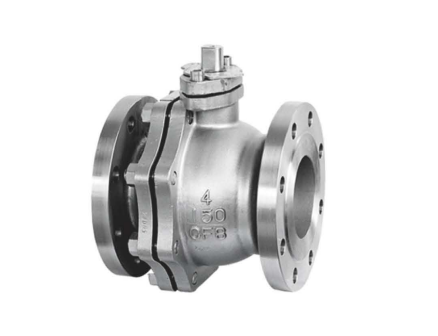
When closed, pressure of the fluid pushes the ball downstream against the seat, enhancing the seal.
The ball is not fixed by a stem or shaft but "floats" between the two seats.
Small to medium valve sizes (generally up to 10 inches)
Moderate pressure systems (up to approximately 1000 psi)
Low to medium temperature fluids
Simple design and cost-effective
Self-adjusting seal that improves with system pressure
Good for general service conditions
Ball movement can cause wear over time, especially at high pressures
Not recommended for very large valves or very high-pressure applications
Requires more torque to operate as pressure increases
A trunnion mounted ball valve has the ball anchored at the top and bottom by trunnions (shaft-like supports). This means the ball does not move axially with pressure changes.
The ball is fixed in place by the trunnions.
Seats are spring-loaded or pressure-assisted to move towards the ball to maintain sealing.
The stem transmits torque to rotate the ball.
Larger valve sizes (typically over 8 inches)
High-pressure systems (above 1000 psi, sometimes up to 5000+ psi)
High-temperature applications
Critical service applications like oil & gas pipelines, refineries, and power plants
Reduced operating torque regardless of pressure
Less wear on seats due to controlled ball movement
Suitable for large and high-pressure valves
More reliable sealing in harsh service conditions
More complex and expensive design
Heavier and larger than floating ball valves
More maintenance required due to additional parts
| Feature | Floating Ball Valve | Trunnion Mounted Ball Valve |
| Ball Support | Ball "floats" between seats | Ball fixed by trunnions at top and bottom |
| Valve Size Range | Typically small to medium (<10") | Medium to large sizes (>8" and up) |
| Pressure Rating | Up to ~1000 psi | High pressure (1000 psi and above) |
| Operating Torque | Increases with pressure | Consistent, lower torque |
| Sealing | Self-energized by pressure | Seat moves to seal against fixed ball |
| Suitability | Moderate pressure and temperature | High pressure, large size, and critical services |
| Cost | More economical | Higher cost due to complexity |
| Maintenance | Simpler, less parts | More parts, potentially more maintenance |
Small to medium pipelines where pressure and temperature are moderate.
Applications where budget constraints exist.
Water treatment, chemical plants, HVAC systems, and general industrial use.
Where valve size is small and simple operation is needed.
High-pressure and high-temperature pipelines.
Large-diameter valves (e.g., in oil and gas, petrochemical, or power generation).
Critical applications needing reliable, low-torque operation.
Systems where valve reliability and long life are paramount despite higher upfront cost.
| Aspect | Floating Ball Valve | Trunnion Mounted Ball Valve |
| Design | Ball floats, supported only by seats | Ball fixed by trunnions |
| Size & Pressure | Smaller size, low to medium pressure | Larger size, high pressure |
| Torque | Increases with pressure | Consistent and lower |
| Cost | Lower cost | Higher cost |
| Maintenance | Simpler | More complex |
Choosing between a floating ball valve and a trunnion type ball valve depends heavily on your system size, pressure, temperature, and application criticality.
If you have a smaller system with moderate pressure and want a cost-effective solution, a floating ball valve is usually your best bet.
For large, high-pressure, or demanding applications where long-term reliability and reduced operating torque are crucial, the trunnion mounted ball valve is the superior choice.
Understanding these differences helps optimize your process, improve valve performance, and reduce costly downtime.